Choosing a calcium silicate ceiling tile by material name alone can leave you with a mismatched grid, unverified fire evidence or a surface that fails under cleaning and condensation. You will be able to compare tile constructions, specify the complete ceiling system, check demanding-room risks and plan installation and maintenance without relying on vague claims such as “moisture resistant.”
Key takeaways
- Treat the tile and suspension grid as one compatible ceiling system.
- Compare fire, moisture, acoustic and impact data against the room’s actual risks.
- Keep spare tiles and lift panels carefully to preserve edges and finishes.
- Record test reports, dimensions, access needs and maintenance terms before ordering.
What calcium silicate ceiling tiles are—and what they are not
A calcium silicate ceiling tile is a rigid, factory-formed panel made from a calcium-silicate matrix with reinforcing fibres. It is designed to sit in a suspended ceiling grid, not to replace the building’s insulation layer; thermal performance also depends on thickness, density, plenum air leakage and continuous insulation.
A calcium silicate ceiling tile is not one uniform product category. Density, thickness, fibre reinforcement, moisture treatment, facing, perforation and edge profile vary, so request mass per square metre, dimensions, tolerances and the finished product’s fire classification.
| Option | What it means | When the difference matters |
|---|---|---|
| Calcium silicate board | A larger rigid sheet for wall lining, fire protection or enclosure work rather than a standard lay-in tile | Do not cut board into tiles without confirming grid support, edges and finish |
| Mineral-fibre tile | A lighter, more forgiving acoustic tile with easier handling and repeated access | Compare load, impact resistance, humidity behaviour and chipped-edge risk |
| Gypsum tile | A gypsum-based tile with a different weight, moisture response and edge behaviour | Use a gypsum tile comparison based on tested performance, not appearance |
| Metal ceiling | A durable formed panel, often washable and impact-resistant | Consider it for frequent cleaning, but compare acoustics, corrosion and cost |
| Cement board | A dense rigid board intended for wet-area or construction applications | It can overload a ceiling grid and is not automatically a compatible tile |
The difference matters in demanding spaces where moisture, fire exposure, cleaning or service access outweigh the lower weight and easier handling of mineral fibre. Check grid span, hanger spacing and allowable load before substituting by nominal module size; repeated removal can chip exposed calcium-silicate edges.
Specify the tile and grid as one compatible system
Before ordering, match the replacement tile to the existing ceiling system, not just its nominal size. Confirm the ceiling tile dimensions, tile thickness, module size, edge profile, surface finish and colour options, then verify that the tile mass per square metre remains within the grid’s allowable load.
Request these suspension details from the manufacturer or installer:
- Grid type: exposed grid or concealed grid, with the compatible tile edge detail
- Tee-bar size, grid span and hanger spacing
- Perimeter detail, including wall angle, shadow gap or seismic restraint
- Access panel dimensions and the approved tile-support method
- Tile tolerances and the number of spare tiles allowed for chipped edges or broken corners
| Grid arrangement | Compatibility check | What can go wrong |
|---|---|---|
| Exposed grid | Confirm the tee-bar face width matches the tile edge and module size | A mismatched edge leaves gaps, rocking tiles or visible grid lines |
| Concealed grid | Confirm clips, kerfs or back supports are supplied for that exact tile | Forced fitting can crack edges and prevent safe removal |
| Fire-rated assembly | Match the tested tile, grid, perimeter detail, penetrations and access panel | A noncombustible tile alone does not preserve the ceiling’s fire-resistance rating |
Check seismic design, grid span and hanger spacing against the complete tile load. Calcium-silicate tiles can weigh more than mineral-fibre alternatives, so replacing tiles without recalculating the suspension system can overload hangers or distort the grid.
Match performance data to the room’s actual risks
Match measured results to room hazards, not room names. Request reports for the supplied finished tile: coatings, facings and perforations can change its fire classification and acoustic performance.
| Space | Prioritise these results | Reject or investigate when |
|---|---|---|
| Bathroom | Relative humidity rating, water absorption and dimensional stability | The rating excludes condensation, direct splashing or wash-down exposure |
| Kitchen | Water absorption, humidity limits, cleanable finish and fire classification | Grease, steam or cleaning water exceeds the documented service environment |
| Plant room | Fire classification to EN 13501-1, ASTM E84 or equivalent test evidence, and dimensional stability | The report covers only the uncoated core, not the supplied finished tile |
| Corridor | Impact resistance, light reflectance and fire classification | Trolleys, ladders or frequent access could damage the face |
| Healthcare area | Acoustic absorption coefficient, cleanable finish, fire classification and humidity rating | Acoustic data applies to a different perforation, fleece or installation |
| School | Impact resistance, NRC ASTM C423 or ISO 11654 rating, and light reflectance | Noise control or repeated ball and ladder impacts are unsupported by test data |
| Workshop | Impact resistance, fire evidence, water absorption and dimensional stability | Dust, vibration, moisture or maintenance activity exceeds stated limits |
A tile’s fire classification is not a fire-resistance assembly rating. For that claim, obtain the tested ceiling construction covering the grid, joints, penetrations, access panels and perimeter details.
Treat thermal conductivity as tile data, not insulation design. Plenum insulation continuity, air leakage and services determine the ceiling’s energy performance. Acoustic results also depend on plenum depth and whether the grid is sealed or open.
Install, access and maintain tiles without damaging performance
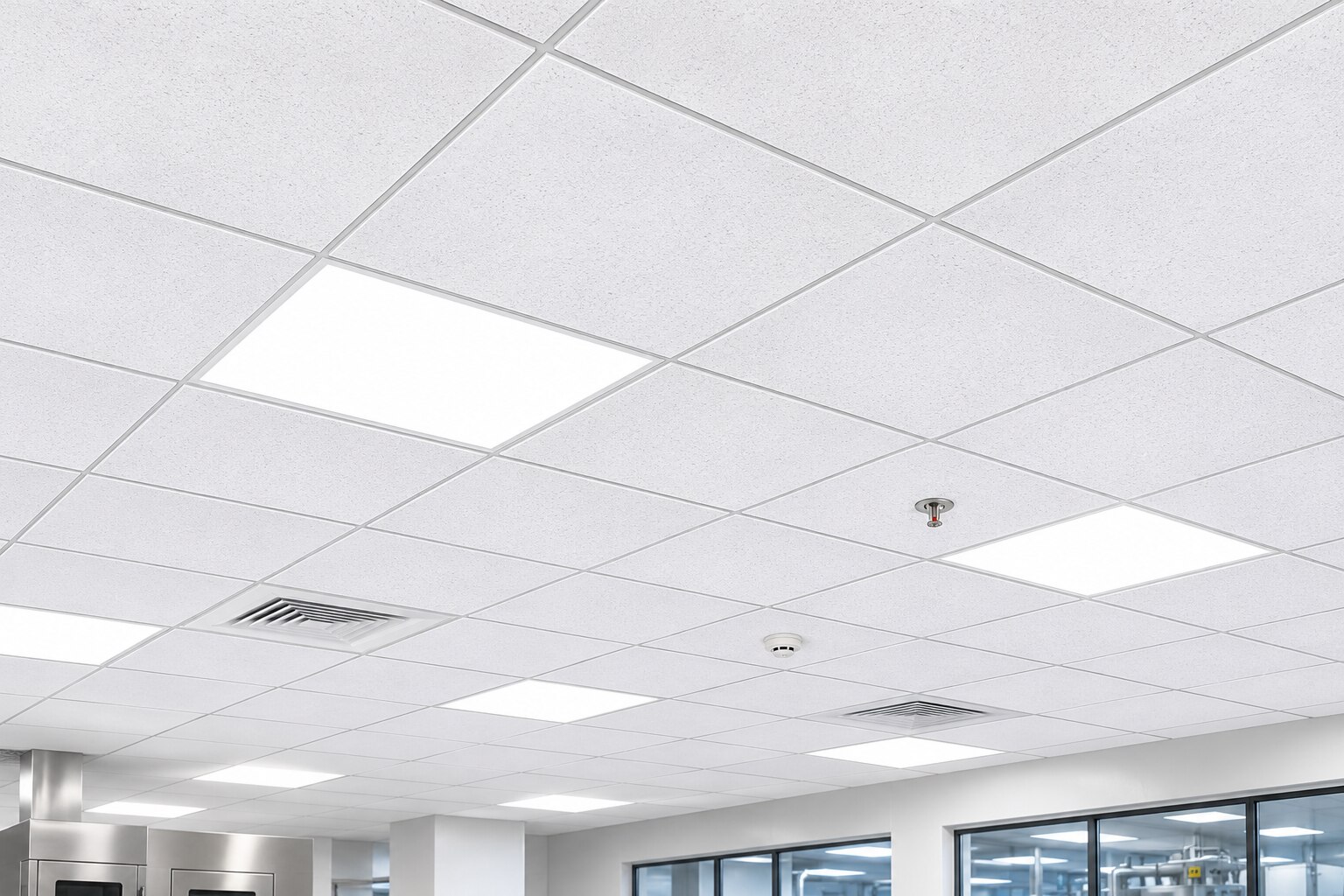
Start with service coordination, not cutting. A sprinkler penetration, luminaire and diffuser openings, speaker, or access panel can leave unsupported edges, unsealed gaps, or a break in the tested ceiling construction. Use only compatible details and confirm the complete assembly’s installation limitations.
- Complete grid levelling before placing tiles, then verify hanger spacing, grid capacity and perimeter support against the specified tile mass.
- Mark every opening from coordinated drawings; do not cut around a sprinkler penetration or service after installation without an approved support and sealing detail.
- Select cutting tools from the product safety data sheet. Apply mineral dust control through wet cutting, local extraction and controlled housekeeping; check whether the formulation creates respirable crystalline silica and use the specified respiratory protection.
- Protect corners during tile handling. Lower tiles vertically, avoid twisting, and keep spare tiles available because repeated access causes edge damage and broken corners.
Clean with the manufacturer’s approved cleaning method; excessive water can cause swelling or staining. Test stain removal on a spare tile before using any chemical, abrasive pad or solvent.
Inspect high-use areas at scheduled intervals for sagging, swelling, cracking and delamination, plus loose edges around service openings. Remove the cause of moisture or grid movement before tile replacement. Replace damaged tiles with the same compatible specification, and never force a new tile into a distorted grid.
Turn the comparison into a defensible procurement decision
Do not approve a substitute because its module matches the existing ceiling. Compare the complete system: tile weight, grid, finish, access pattern and room hazards.
| Option | Main advantage | Check before selection |
|---|---|---|
| Calcium silicate | Stable in humid interiors | Tile mass per square metre, edge brittleness, condensation risk and water-exposure limits |
| Mineral fibre | Lower dead load and easier handling | Humidity rating, impact damage and airborne contaminants lodging in the surface |
| Gypsum | Smooth appearance and predictable finishing | Water damage, repeated access and suitability for wash-down exposure |
| Metal | Durable, cleanable and easily accessed | Acoustic treatment, corrosion resistance, sharp edges and higher cost of grid components |
| Cement board | Tough facing for harsh service areas | Weight, cutting dust, joint detail and compatibility with a demountable grid |
Put these requirements into the procurement specification:
- State tile mass per square metre, thickness, dimensions, edge profile and allowable tolerances; then check dead load, grid capacity, hanger spacing and seismic requirements as one design.
- Request the finished-product classification for the supplied coating, facing and perforation, not only the core classification.
- Match the moisture limit to condensation risk and wash-down exposure. “Moisture resistant” alone is not acceptance evidence.
- Request a product safety data sheet before cutting or sanding; control airborne contaminants with extraction, wet methods and specified respiratory protection.
- Set a spare tiles allowance and replacement procedure where frequent access could chip edges.
Ask Keshar Gypsum Pvt Ltd - 08048034025 for comparable schedules when reviewing tile, board and grid options; reject any quote that omits test documents or system compatibility.
Frequently asked questions
Are calcium silicate ceiling tiles insulation?
No. They are rigid suspended-ceiling panels, not a replacement for continuous building insulation. Thermal performance also depends on thickness, density, plenum air leakage and insulation continuity.
Why specify the ceiling tile and grid together?
Tile dimensions, edge profile, weight and suspension compatibility determine fit, stability, alignment and access. Specify both as one tested system.
Which performance properties should you compare?
Match documented fire performance, moisture resistance, acoustic absorption, impact resistance, cleanability and dimensional stability to the room’s actual risks.
How do you maintain calcium silicate ceiling tiles?
Use the manufacturer’s cleaning method, lift tiles with clean hands or suitable tools, avoid damaging edges and finishes, and keep replacement tiles available for access or repairs.