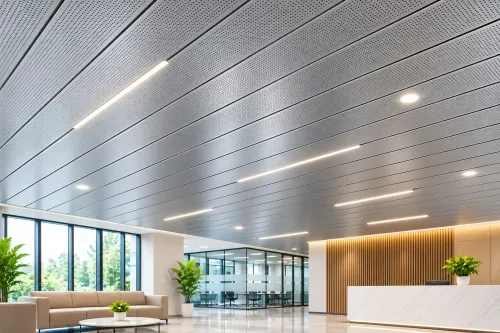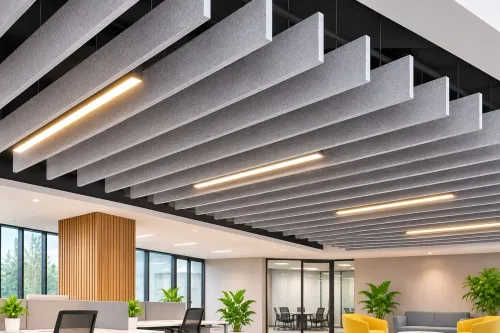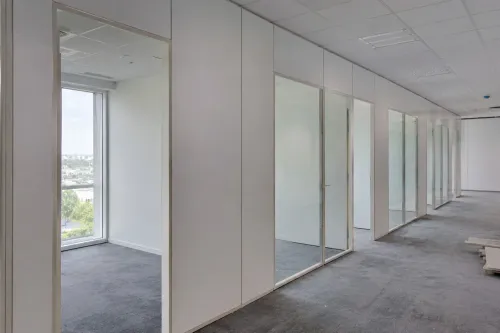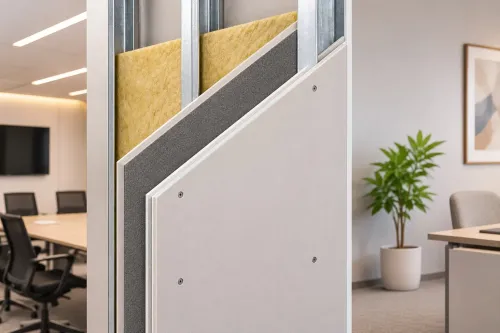
Echo in a large hall comes from repeated reflections between hard ceilings, walls and floors, not from sound passing through a partition. You will learn how to distinguish absorption from sound insulation, specify the complete panel build-up, estimate the treatment area and check whether the finished room can meet its reverberation and speech-intelligibility targets.
Key takeaways
- Use perforations, an air cavity and porous backing to absorb reflected sound.
- Match treatment placement to whether the problem is echo, reverberation or speech clarity.
- Compare systems using sound absorption data, not perforation patterns alone.
- Specify the board, backing, cavity, framing and coverage as one acoustic system.
How Perforated Gypsum Board Controls Reflections
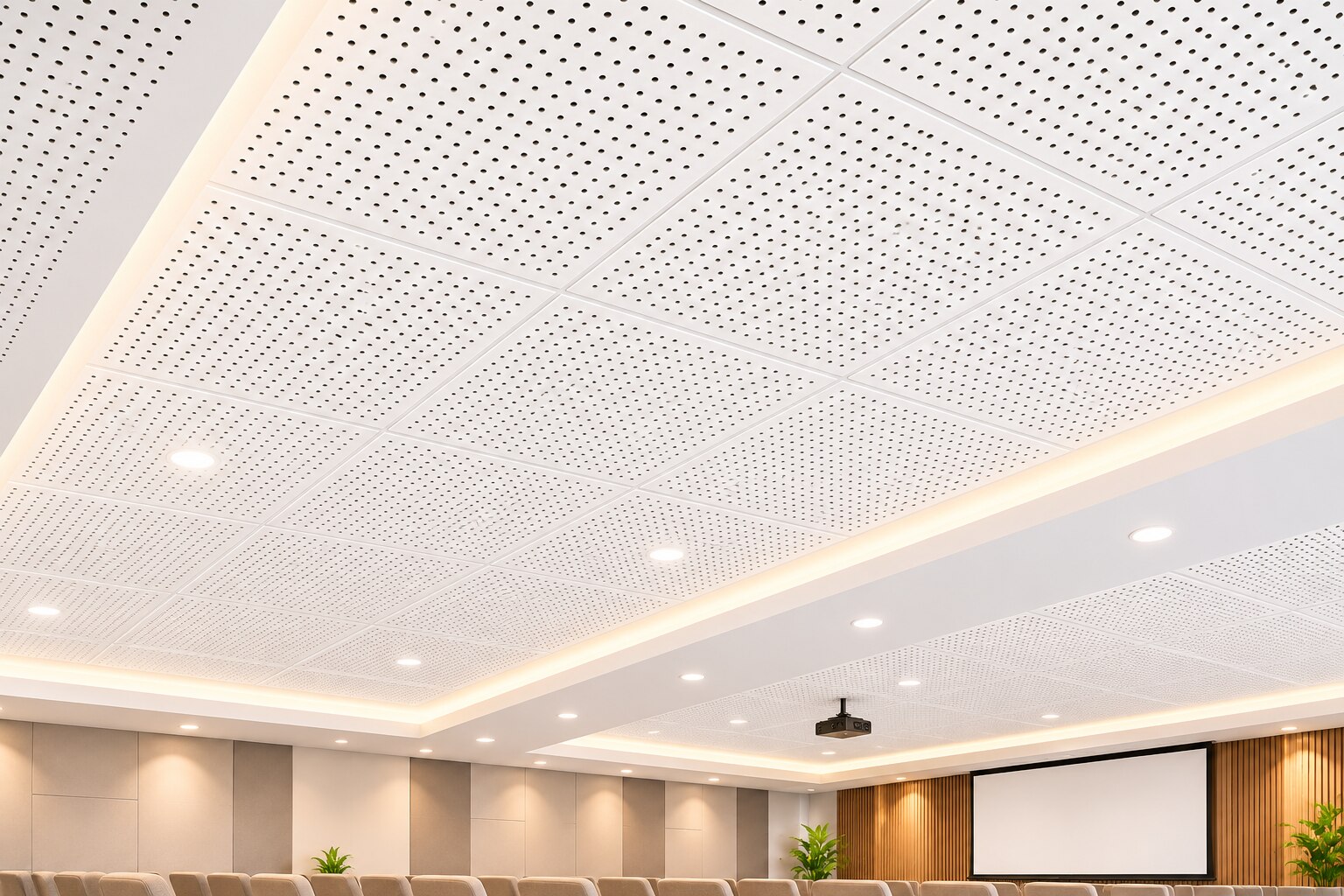
A perforated gypsum board reduces reflected sound inside a room. Sound enters the holes and drives the air in the cavity behind the board; a porous backing converts part of that motion into heat. The result is sound absorption and shorter, weaker reflections, which supports echo control.
The absorption peak depends on the complete panel build-up, not on the perforation pattern alone.
That is different from sound insulation. An insulated wall or Soundbloc-type partition is designed to resist sound transmission through the construction, improving its sound transmission loss ratio between adjoining spaces. A perforated panel mainly treats sound after it enters the room.
Leave its cavity unsealed or omit the acoustically appropriate backing, and sound can couple into the ceiling plenum while the panel loses absorption and partition performance. Treating only the ceiling also leaves untreated walls and floors able to return late reflections.
Before comparing systems, request:
- Sound absorption coefficient by frequency, not only one overall rating
- Weighted absorption coefficient or NRC, where provided
- The test standard and build-up, such as ISO 354 or ASTM C423, including cavity depth and backing used
Choose the Treatment Around the Room’s Acoustic Problem
Choose perforated gypsum board where speech, music or announcements linger after the source stops. Auditoriums, cafeterias, classrooms, religious halls, gyms, offices, transit spaces and reception spaces benefit when large volumes combine hard, reflective finishes with too little exposed absorption.
| Space or condition | Acoustic problem | Treatment decision |
|---|---|---|
| Auditoriums and religious halls | Long reverberation and late reflections obscure speech or music | Treat the ceiling and upper walls; protect sightlines and avoid concentrating absorption only above the audience |
| Cafeterias, classrooms and offices | Conversation noise reflects between hard floors, glazing and partitions | Use distributed ceiling panels, with additional wall absorption where seats or desks leave walls exposed |
| Gyms and transit spaces | High volume, hard surfaces and intermittent loud sounds create persistent echoes | Combine overhead absorption with end-wall or upper-wall treatment |
| Reception spaces | Voices reflect across stone, glass and metal finishes | Treat the ceiling and the largest opposing hard wall |
Volume and ceiling height set the scale of the problem: a tall, spacious room holds more sound energy and gives reflections longer paths, while an empty room sounds worse because people and furnishings are absent. Hard floors, glazing and painted masonry increase reflection; occupied seating, curtains and upholstered furniture provide useful absorption.
Do not count the gross ceiling area. Deduct lights, grilles, access panels, sprinklers, beams and service zones, then check the net exposed acoustic area. If untreated end walls, balconies or upper walls remain reflective, ceiling treatment alone will not stop flutter echo.
Specify the backing and sealed cavity; open perforations into the plenum do not guarantee useful absorption.
Compare Performance Using the Right Acoustic Measurements
Request the sound absorption coefficient by frequency, not just a headline rating. Compare the complete curve at 125, 250, 500, 1,000, 2,000 and 4,000 Hz so you can see whether the panel controls speech, music or low-frequency rumble.
| Figure or detail | What it tells you | What to request |
|---|---|---|
| NRC | A single rounded absorption index | NRC calculation at 250 500 1000 and 2000 Hz; it is rounded to the nearest 0.05 and says little below 250 Hz |
| Weighted absorption coefficient | A weighted rating based on the absorption curve | αw, with the ISO 354 reverberation-room result and ISO 11654 rating method |
| Test result | How the specimen performed under controlled conditions | ASTM C423 or ISO 354 report, including the mounting method |
| Construction tested | Whether the result represents your proposed build-up | Exposed area, board thickness, perforation pattern, cavity depth, backing and any insulation |
Ask for these details before comparing products:
- State the hole diameter, spacing and open-area percentage, but do not rank boards by open area alone. Similar open areas can produce different curves when thickness, cavity depth or backing changes.
- Confirm whether the test used acoustic fleece, mineral wool or another backing. Fleece is not proof of a specified mineral-wool thickness and density.
- Check the mounting description. A result for a deep, sealed cavity cannot be treated as the board’s intrinsic performance or transferred to a shallow, open plenum.
Calculate Coverage and Specify the Complete Ceiling or Wall Build-Up
Size the treatment from equivalent absorption area, not from the board’s NRC alone. For a preliminary estimate, use the Sabine equation T = 0.161V/A, where T is reverberation time, V is room volume in cubic metres, and A is total equivalent absorption in sabins.
A 300 m³ room with a 1.2-second target needs A = 40.25 sabins; if existing finishes provide 20 sabins, you need 20.25 more. At an effective coefficient of 0.80, that equals about 25.3 m² of installed board before mounting and edge-condition allowances.
For speech, specify STI or C50 as well as RT60; a compliant reverberation time does not guarantee clear announcements.
| Location | Acoustic purpose | Design caution |
|---|---|---|
| Ceiling field | Controls overhead reflections across the room | Do not leave large uninterrupted hard zones around lights, ducts or beams |
| Upper end wall | Limits late reflections and flutter between end surfaces | Prioritise the wall facing the speaker or stage |
| Upper side walls | Reduces lateral buildup and uneven coverage | Preserve useful early reflections in lecture or performance spaces |
| Balcony fronts or rear walls | Treats strong return paths in tiered rooms | Check sightlines, impact protection and access |
- Specify the board perforation pattern, thickness, exposed area and tested absorption by frequency.
- State the backing material, air cavity depth, framing, fasteners, joints and perimeter seals; each changes the result.
- Request the ASTM C423 mounting description, including backing and cavity depth, rather than accepting a standalone NRC.
- Keep fire resistance and reaction-to-fire classification separate from absorption, and use only a complete tested assembly where the ceiling or partition has a rating.
Verify the Installed System Before You Approve the Purchase
Approve the complete build-up, not the perforated face board alone. The drawings, sample, laboratory evidence and installation records must describe the same acoustic fleece, mineral wool backing density and cavity depth.
1. Check the reflected ceiling or wall plan for panel area, location and continuity. Confirm that untreated end walls, upper walls, balconies or hard floor zones will not leave a flutter-echo path.
2. Inspect a full-size sample with perforations, acoustic fleece, joints, edge details and the specified finish. The fleece preserves the appearance behind the holes; it does not replace a stated mineral wool layer.
3. Request an ISO 354 or ASTM C423 report for the complete assembly. Match the report to your proposed board thickness, exposed area, backing construction, mounting method and cavity depth.
4. Compare sound absorption coefficient by frequency, not open-area percentage alone. Two boards with similar perforation ratios can absorb very differently because hole size, board thickness, cavity and backing change the absorption curve.
5. Read the installation specification for suspension spacing, sealed perimeter edges, access panels, service penetrations and mineral wool placement. An open or poorly sealed cavity can couple the room to the plenum and reduce the promised absorption.
6. Require delivery records identifying board type, fleece, insulation product, backing density and batch details. Photograph concealed layers before closure and record deviations on the as-built drawing.
Keshar Gypsum Pvt Ltd - 08048034025 can help separate the board, backing, suspension and finishing costs in a Maharashtra procurement schedule, preventing a low board price from hiding an incomplete acoustic system.
Frequently asked questions
How does perforated gypsum board reduce echo?
Sound enters the perforations and moves air in the cavity behind the board. Porous backing converts part of that motion into heat, reducing reflected sound.
Where should you place perforated gypsum board in a large room?
Place treatment around the surfaces creating the problem: ceiling areas for overhead reflections, walls for lateral reflections, and targeted zones when speech clarity is the priority.
Which acoustic measurements should you compare?
Compare laboratory sound-absorption data for the complete build-up, including the board, backing, cavity and framing. Do not compare perforation patterns alone.
What should an acoustic gypsum board specification include?
Specify the board pattern, backing material, cavity depth, support system, joint treatment, total coverage and installation details so the approved system matches the tested build-up.